About the project
In Germany, more than 2,000 Jewish cemeteries have survived from the 11th century onwards. No other European country has – despite great losses – a comparably old, rich and multi-layered tradition. These cemeteries are among the oldest examples of local sepulchral culture. Their preservation, documentation, development and communication is a task of importance to society as a whole. Nevertheless, they have not yet received the attention they deserve as places of remembrance, as expressions of individual and corporate Jewish identity and as historical and material sources.
Stone Witnesses Digital” aims to change this. The project builds on many years of experience in researching Jewish burial culture. Since 2002, the epigraphic database epidat has been developed at the Salomon Ludwig Steinheim Institute for German-Jewish History under the direction of Prof. Dr. Michael Brocke. It now contains over 50,000 inscriptions in words and images, in Hebrew and German, and has met with an international response from academics and the wider public alike. Thanks to the relevant expertise of the Bamberg colleagues, the spatial and material dimensions of the cemeteries can now also be examined and digitally documented throughout the joint project. The focus here is on the rich early modern tradition, which has so far remained largely untapped.

A student employee during the scanning process of the cemetery grounds with the mobile laser scanner; Photo: Benjamin Herges; Source: University of Bamberg
Research program
The project begins at the end of the Middle Ages, when the focus of Jewish settlement activity shifted from the old urban centers to rural regions as a result of the almost nationwide expulsions of the ‘long’ 15th century. It includes the age of Jewish enlightenment in the 18th century and that of emancipation from the turn of the 19th century onwards.
According to a preliminary overview, around 590 Jewish cemeteries founded between 1500 and 1800 still exist within the borders of the Federal Republic of Germany; the number of gravestones preserved in these cemeteries is certainly in the six-figure range. In view of this situation, the project must make an exemplary selection. As a result, the work program is divided into three clusters with a total of eight three-year modules, which build on each other in terms of time and theme and follow the major lines of German-Jewish history.
The first and most extensive cluster, which consists of four modules, focuses on the rural association cemeteries of southern Germany, some of which date back to the 16th century. The second cluster is dedicated to a series of cemeteries in the urban environment, as they emerged in the course of the consolidation of the Jewish settlement structure after the Thirty Years’ War. Finally, Cluster III traces the different paths to modernity that opened up in the wake of the Enlightenment and emancipation, including different ways of dealing with the Hebrew tradition that go back as far as the 19th century.
Clusters and modules
I
After the expulsions
1-4
Cemeteries in the
rural area
Years 1-12
2023-2034
II
Start-up & consolidation
5-6
Community cemeteries
in the urban environment after
the 30-year war
Years 13-18
2023-2034
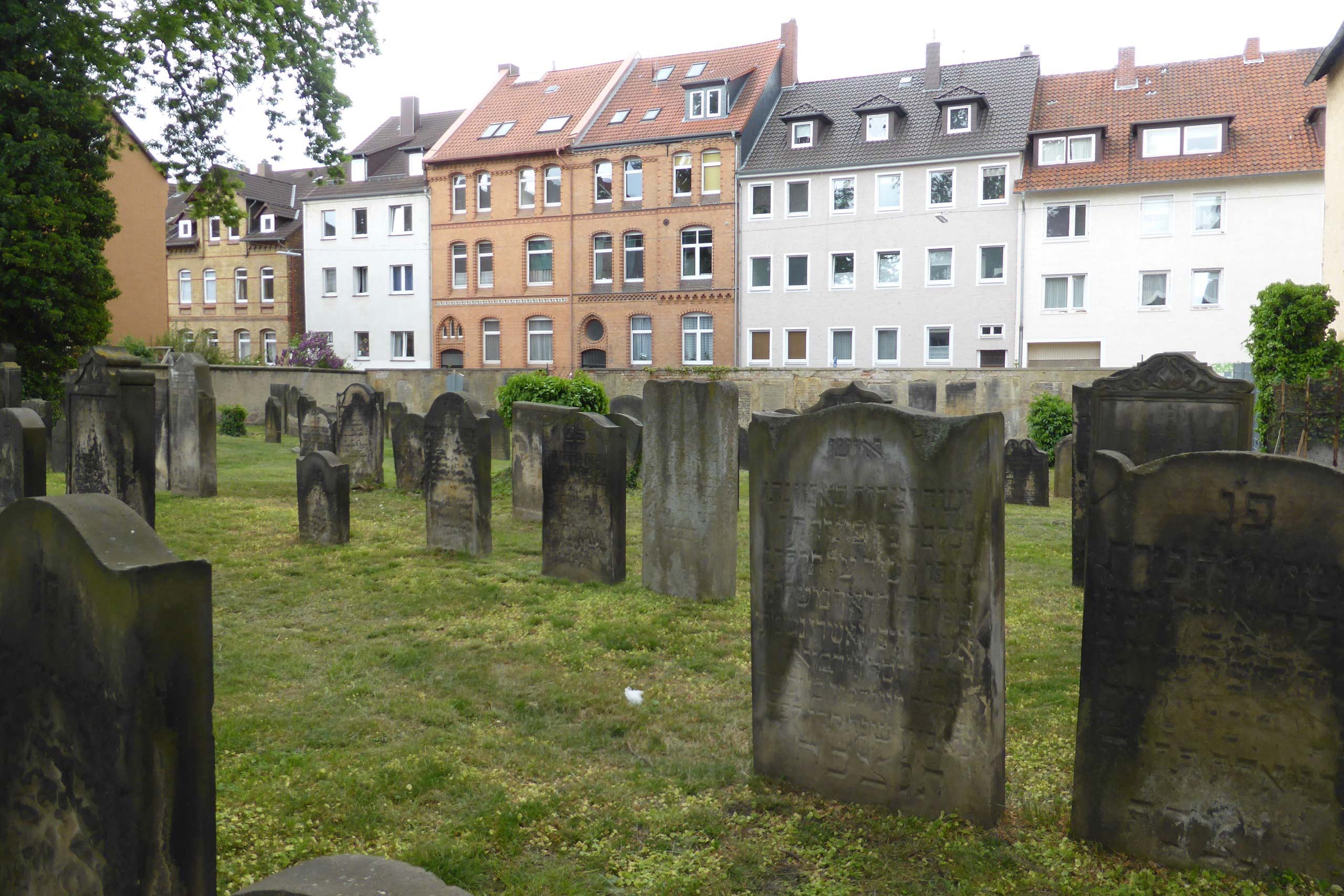
III
Paths into the modern age
7-8
Cemeteries between Haskala
and neo-orthodoxy
Years 19-24
2041-2046
Interdisciplinarity
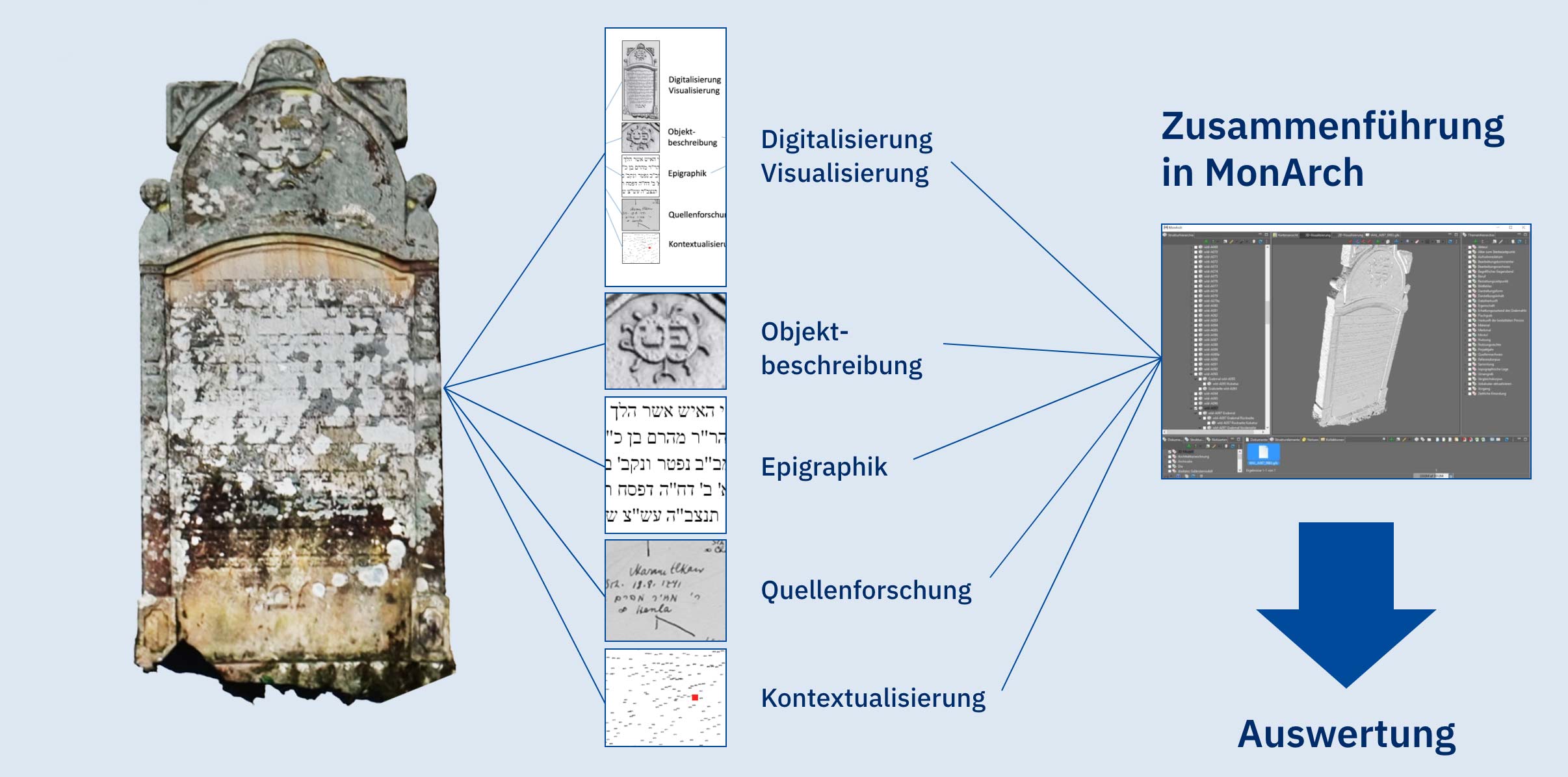
The strength of the project lies in its interdisciplinary collaborative research. For example, the digital monument technologies – beyond topographical recording – create 3D models of gravestones whose inscriptions are no longer legible due to weathering. The epigraphy team can profitably use these models for the transcription and translation of the inscriptions in addition to resorting to photographs. Building research, in turn, takes on the analysis of form, condition and materiality and systematically records and models these characteristics for quantitative evaluation as so-called semantic graphs. The aim is to bring together all the data obtained from the disciplines in a joint research data management system.
Multimodal approach
Current work
The first cluster focuses on the rural association cemeteries in southern Germany. The selection of the cemeteries studied is aimed at a representative spectrum of different cemetery types, in each of which the dynamic relationship between settlement and cemetery network manifests itself in its own way.
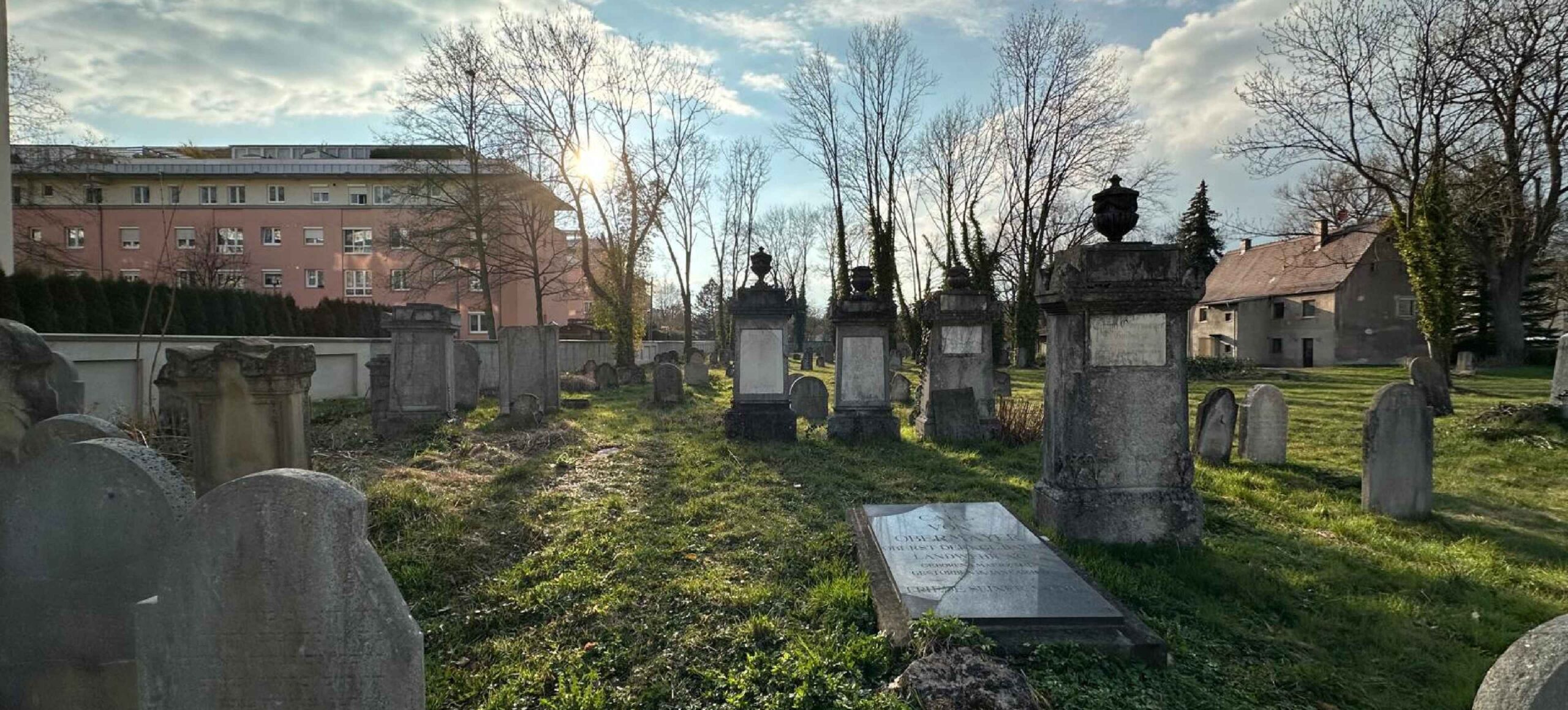
One example is the suburban cemeteries in Jewish settlement areas close to the city center, which were themselves closed to Jewish settlement. This is the case with the Jewish cemetery in Kriegshaber, a village on the outskirts of the imperial city of Augsburg, which expelled its Jews in 1438. Things were different in Walsdorf, where the Jews of the prince-bishopric of Bamberg buried their dead. Although there was a Jewish community in the residential town itself, around ten kilometers away, the establishment of its own cemetery was only permitted there in 1851.
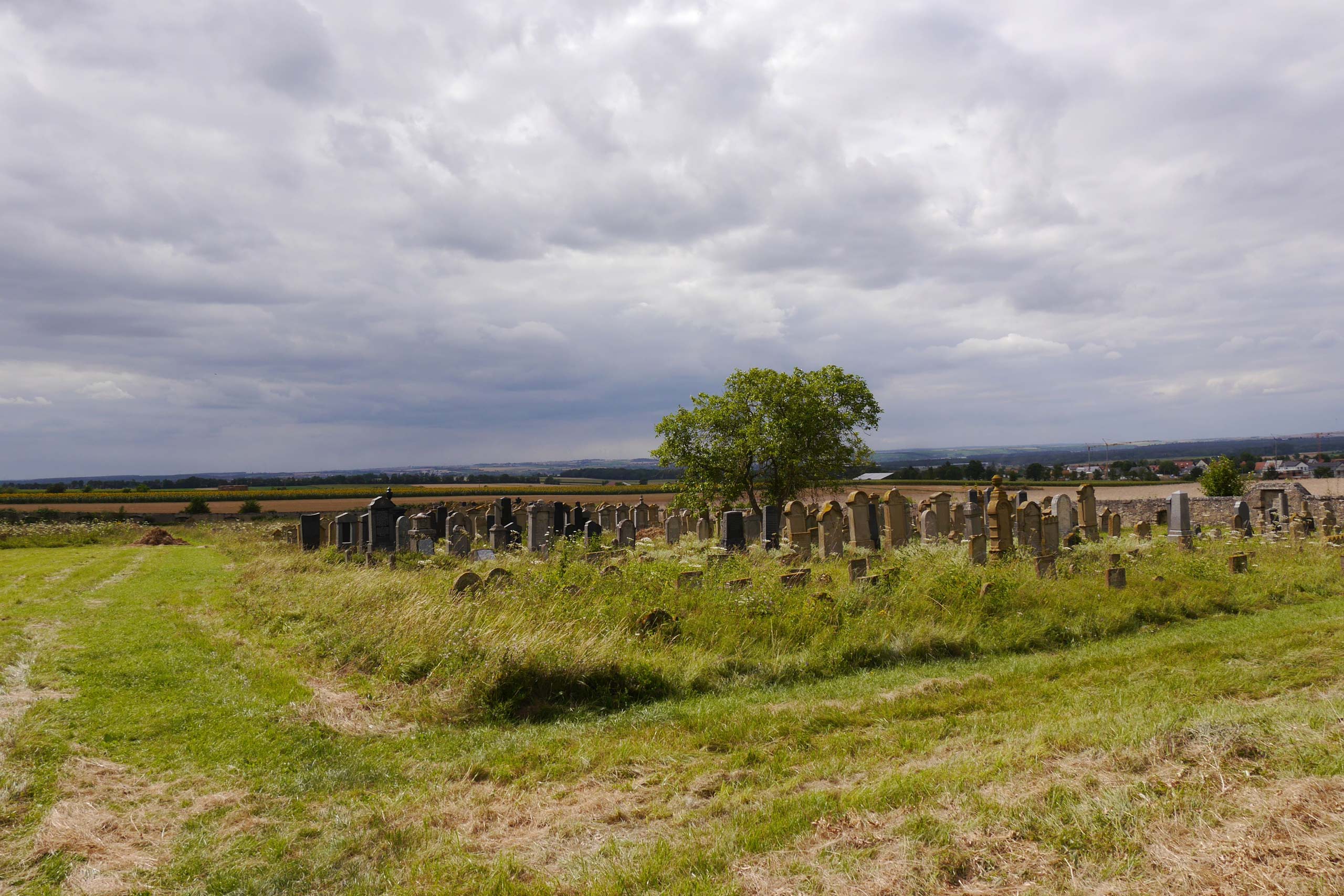
Walsdorf cemetery (Upper Franconia)
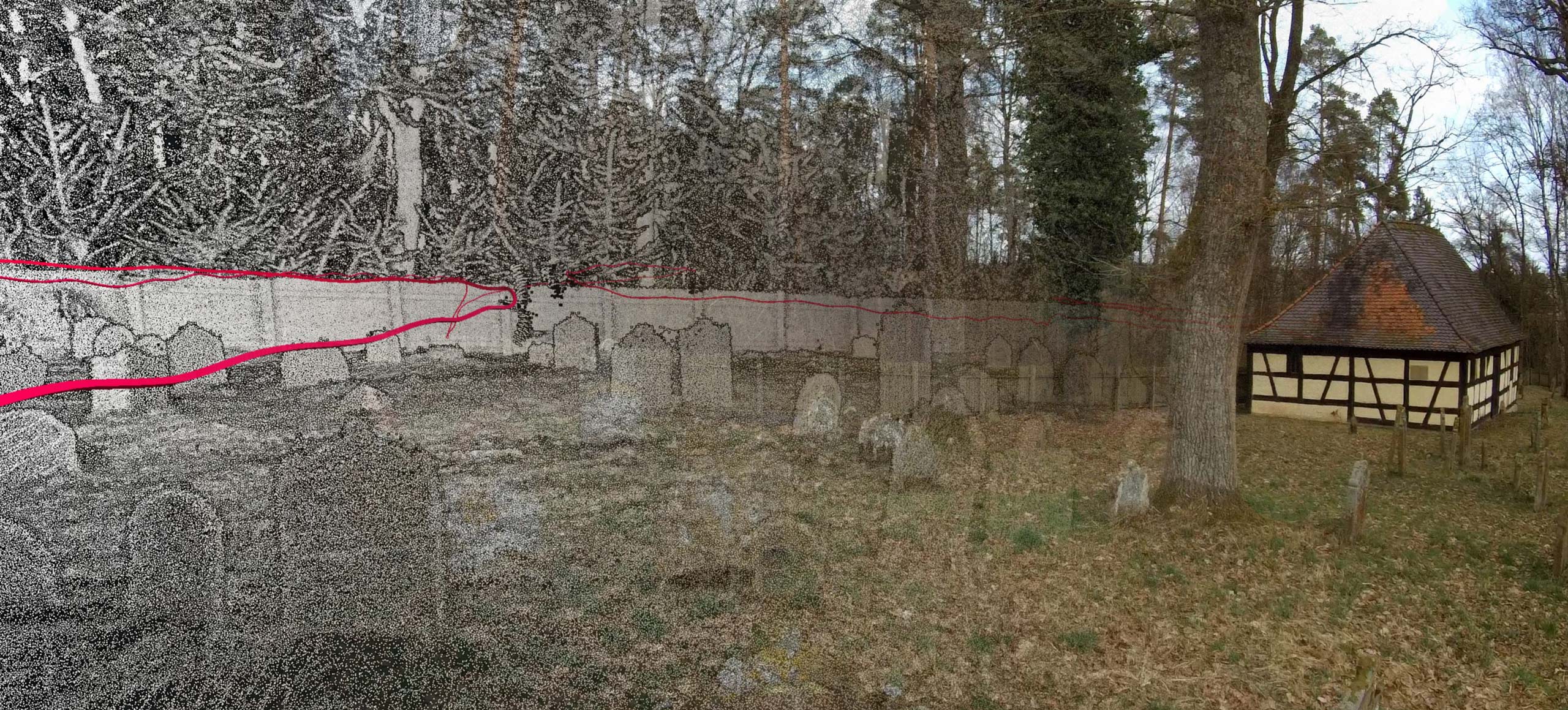
The association cemetery in Walsdorf, a small aristocratic residence near Bamberg, was established in 1628. The Jews of Bischberg, Burgebrach, Viereth, Trunstadt and Walsdorf buried their dead here alongside the Jewish community of the prince-bishop’s residence town. A tahara house for the ritual ablution of the deceased was built in 1742. Many of the almost 1,100 stones are heavily weathered, so that epigraphic recording is urgent. Many of the tombs are elaborately designed and show the influence of Bamberg Baroque.
Kriegshaber cemetery (Bavarian Swabia)
Founded in 1627, the Kriegshaber cemetery with its around 530 gravestones is part of a succession of early modern burial grounds with which the Jews of the surrounding area sought to compensate for the loss of the medieval central cemetery in Augsburg. Apart from Kriegshaber itself, the cemetery was used by the Jews of Steppach, Pfersee and Fischach. It was extended in 1695 and 1722, and a wall was built to protect the cemetery in 1825. Compared to Walsdorf, the gravestones in Kriegshaber are formally less complex. With the exception of those from the second half of the 19th century, the inscriptions are well preserved.